

In the competitive corporate landscape, mistakes are inevitable. Whether it is a product flaw, a service error, or a communication mishap, no company is immune to the occasional misstep. However, what truly sets successful businesses apart is not the absence of mistakes but their ability to respond effectively when they occur.
Let’s explore why a company's response to a mistake can be more crucial than the mistake itself and how that response can impact its reputation, customer trust, and long-term success.
What Juror Data Tells Us
During a mock trial our team facilitated, 91% of the jurors believed that how a company responds to a mistake on their part is as important as the mishap itself.
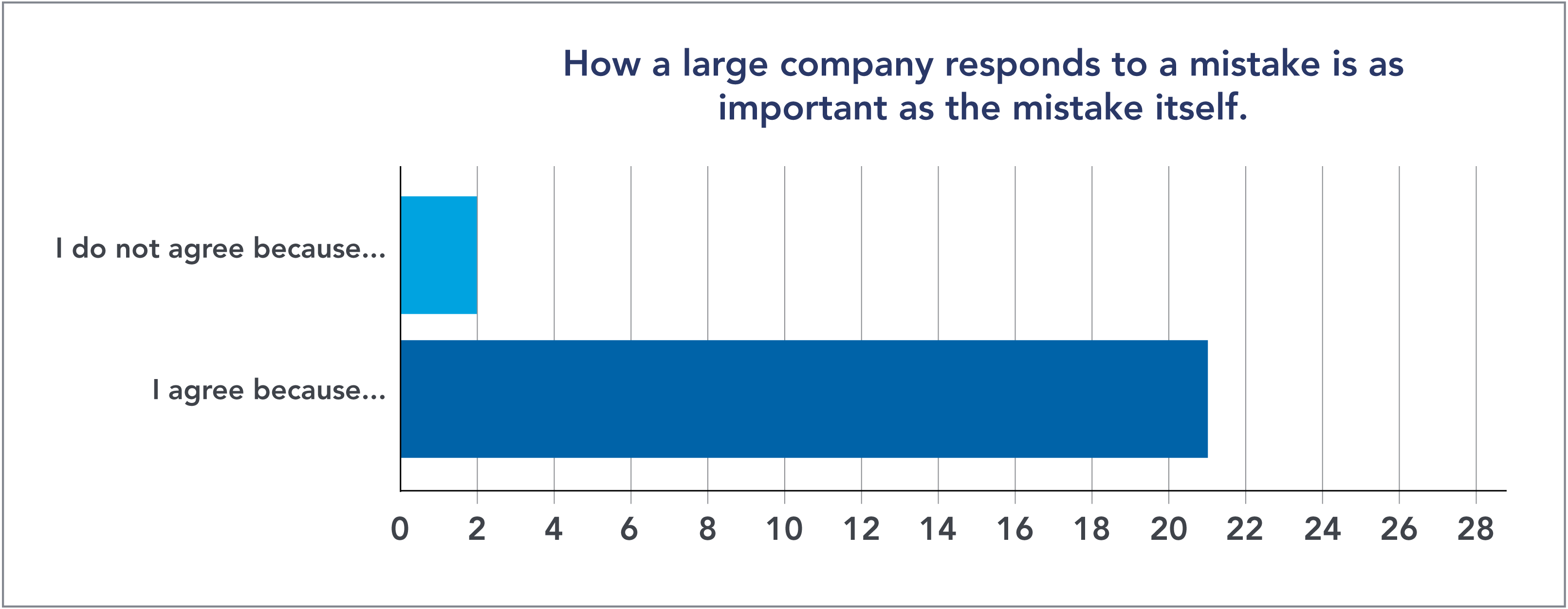
We have seen a similar response to the same question in numerous jury research projects. Several jurors further explained their thoughts on this topic:
- “It doesn't matter if it's a large or small company.”
- “If a mistake is made, how you handle it shows the integrity of the business.”
- “Mistakes are made, part of life. Own up to it. Learn from it and go forward.”
- "Integrity and trust are important. People will choose who to trust.”
Although this same concept can be applied to individuals who want to reduce blame and anger after a misstep, our research has shown that companies are often held to higher expectations of perfection than individuals are. To mitigate anger and criticism towards a company that has committed a blunder, the solution is a swift and effective response to the mistake.
Five Ways to Respond Well
1) Build Trust Through Transparency
When a company acknowledges its mistakes openly and transparently, it demonstrates authenticity and accountability. Consumers appreciate honesty, and admitting faults is a critical step toward rebuilding trust. Transparency in communication during a crisis not only reassures customers but also humanizes the brand, making it more relatable.
Our jury consultants recommend that companies “always accept responsibility,” but this does not mean admitting fault. While accepting responsibility may imply acknowledgment of fault, it can also entail sincerely expressing empathy for the injured party while honestly asserting the company’s innocence.
2) Turn Mistakes into Opportunities
Instead of viewing mistakes as setbacks, forward-thinking companies see them as opportunities for improvement. By actively addressing and rectifying errors, a company can showcase its commitment to both corporate responsibility and continuous improvement. Embracing mistakes as learning experiences can lead to enhanced products, services, and internal processes, ultimately making the company stronger.
In our focus group and mock trial exercises, jurors adamantly want to see concrete examples of companies that have used mistakes to improve their processes. Companies should communicate that they cannot foresee every possible issue, but they can learn how to fix the issue once it arises.
3) Employ a Customer-Centric Approach
A company's success is intricately linked to its relationship with its customers. When a mistake occurs, a customer-centric response is paramount. Swiftly addressing the issue, providing solutions, and ensuring customer satisfaction can turn a negative experience into a positive one.
Companies that prioritize customer needs and concerns during challenging times are more likely to retain customer loyalty. If the company has a strong connection to its customers, they may be less likely to take action if a mistake occurs. Also, if the post-mistake response to customers is compassionate and understanding, the company will place itself on the high ground in others’ eyes.
4) Preserve Company Reputations
A company's reputation is one of its most valuable assets. A poorly managed mistake can tarnish a brand's image, leading to long-lasting consequences. Conversely, a well-handled response can mitigate damage and, in some cases, even enhance a company's reputation. Reputation management should be a key component of any crisis response strategy.
5) Foster Organizational Culture
How a company handles mistakes internally reflects its organizational culture. Employees are more likely to remain engaged and motivated in an environment where errors are acknowledged and constructive solutions are sought. A culture that supports learning from mistakes fosters innovation and resilience.
Often, in mock trials and focus groups, we see that companies that offer constructive criticism and support their employees, even when mistakes happen, are elevated in the jurors’ estimation. It can also be helpful to illustrate examples of when a mistake occurred and how the company worked with the employee to find solutions and make reparations.
Building Trust Beyond the Mistake
In the ever-evolving business setting, mistakes are inevitable, but their impact can be alleviated by a company's response. The way a company addresses and learns from its mistakes is a true testament to its resilience, integrity, and commitment to its stakeholders.
By viewing mistakes as opportunities for growth, communicating transparently, and prioritizing customer satisfaction, companies can turn challenges into stepping stones toward long-term success. After all, it's not the mistake itself but the response that defines a company's destiny.
Originally published by First Court in 2022; updated/republished by IMS Legal Strategies in 2026. Read about our strategic union here.