

Trial lawyers spend significant time refining themes, witnesses, and arguments. Yet even a strong case can lose momentum when jurors do not understand the language being used. As seen in real and mock proceedings, attorneys often overestimate jurors' familiarity with commonly used legal and business terminology.
When Common Language Isn't So Common
During a mock trial involving a Manhattan jury pool, one attorney referred to a “red herring,” a phrase we have heard countless times before mock and trial juries. It never dawned on us that the term might confuse them. In this instance, our research team asked jurors to define the phrase in their own words. The results revealed a substantial gap between attorney assumptions and juror understanding.
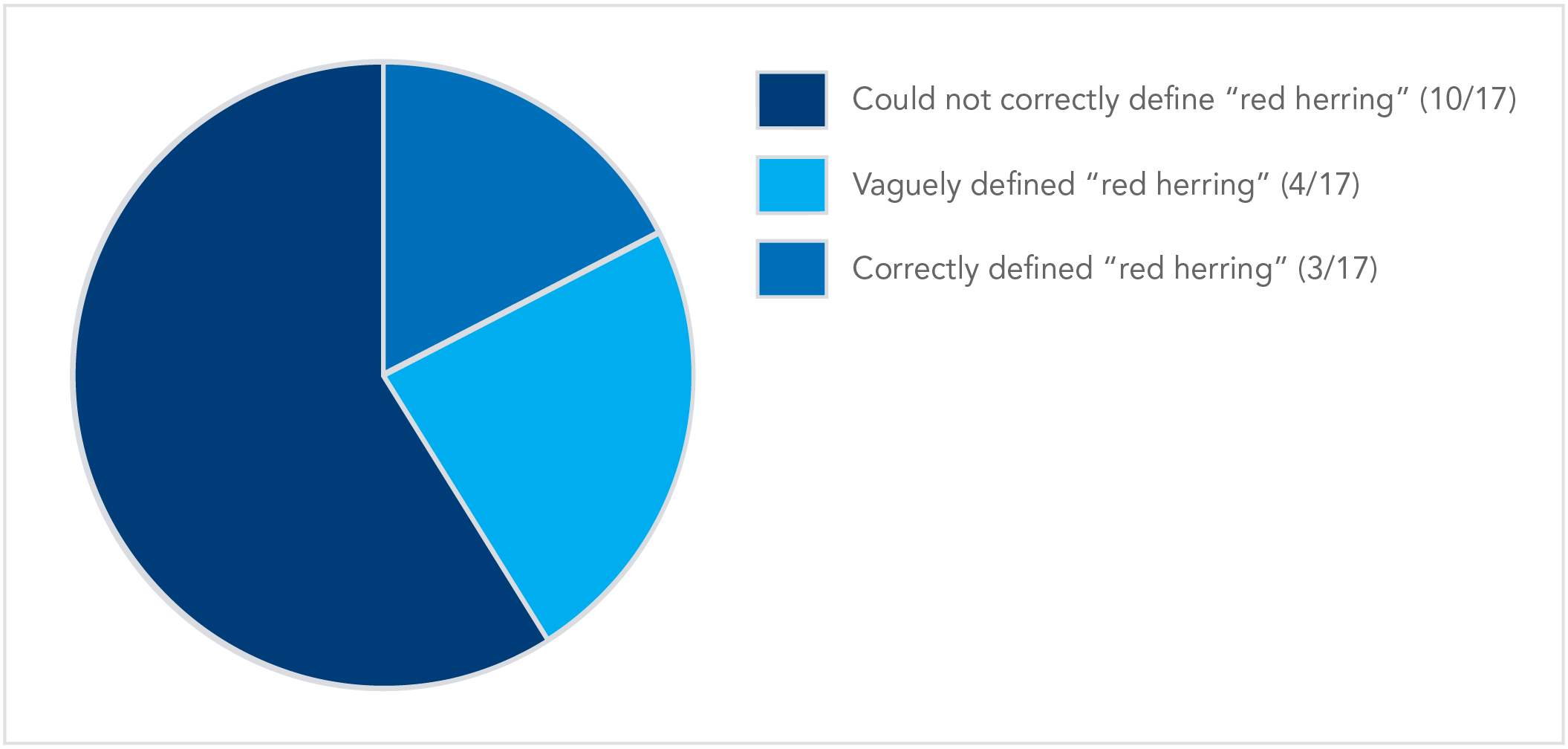
Of the 17 mock juror respondents, representing diverse educational and demographic backgrounds, only three defined the term 'red herring' with accuracy. Four had a vague sense of its meaning, while ten did not understand the phrase. Eight openly acknowledged their confusion, and two provided incorrect definitions.
These surprising mock trial findings suggest that even phrases attorneys consider commonplace may create unintended barriers to courtroom communication. It also broadens our reasoning for avoiding terminology that jurors may not understand.
How Confusing Language Can Undermine a Case
1) It Creates Psychological Distance
When jurors encounter unfamiliar terminology, they may view counsel as disconnected from their experience. If they feel alienated or unable to understand you, it can be difficult to build rapport and to advocate effectively.
2) It Reduces Juror Engagement
Confused jurors are more likely to become distracted and disengaged from the presentation. Even if the facts and arguments are on your side, strong evidence loses its impact when jurors are tuned out.
3) It Increases Reliance on Emotion
Jurors who struggle to understand an argument may rely more heavily on emotion, demeanor, and body language when evaluating evidence and testimony. To keep jurors grounded in reason, you need to ensure that your message gets through.
Where Clear Language Adds an Advantage
The plain-language movement is often associated with legal documents, but the same principle applies in the courtroom. Jurors process information more effectively when attorneys use clear, familiar language. Replacing jargon with straightforward communication can improve attention, comprehension, recall, and ultimately persuasion.
Every word used at trial influences how jurors receive a case. Before using a phrase that feels familiar within the legal profession, consider whether jurors will interpret it the same way. Clear communication strengthens credibility and helps ensure that jurors focus on the evidence rather than the vocabulary.
If revenge is a dish best served cold, in court, a red herring is best not served at all.
Originally published by First Court in 2022; updated/republished by IMS Legal Strategies in 2026. Read about our strategic union here.